


Online sales funnel: how to achieve more conversion in 2024 in 6 steps
An online sales funnel gives insight into the path potential customers travel before they make a purchase or get in touch with your organisation. It is an indispensable part of online marketing, because it helps direct targeted traffic to your website and convert it into valuable conversions. In this article you will learn how to build and optimise a successful online sales funnel in 2024 in order to generate more conversions.
Before we start, some context:
What is a sales funnel?
A sales funnel is a process in which potential customers are guided through various phases so that they eventually make a purchase or get in touch with your company. This 'funnel' starts wide (many visitors) but narrows as the process progresses, leaving only the most interested prospects (lead generation). A well-optimised sales funnel gives you the chance to offer a pleasant customer experience, from the first point of contact to the eventual conversion.
What is online?
Something is online when it has an active connection to a network. So it is whatever takes place through the internet.
How do you generate online traffic in 2024?
Generating online traffic remains a crucial part of the sales funnel. With the growth of online sales and digital marketing it is important to understand which channels work best for your sector. While some markets are already saturated, in other niches you can be a pioneer. So analyse the competition and the trends in your market before you determine your online strategy.
In 2024 there are new options for attracting traffic, such as TikTok advertising, voice search optimisation, and Google's newest AI-driven search functionality. To stay abreast of these developments, it is wise to review your digital strategy regularly.
In this explanation we cover the following 5 subjects:
The structure of a sales funnel
Defining your audience
The three biggest mistakes
Customer journey
Optimising your sales funnel
The structure of an online sales funnel
There are various models for building a sales funnel, but the AIDA model remains a classic. AIDA stands for Awareness, Interest, Desire and Action. This model helps you understand the customer journey and how you can optimise it (E.K. Strong – 1925).
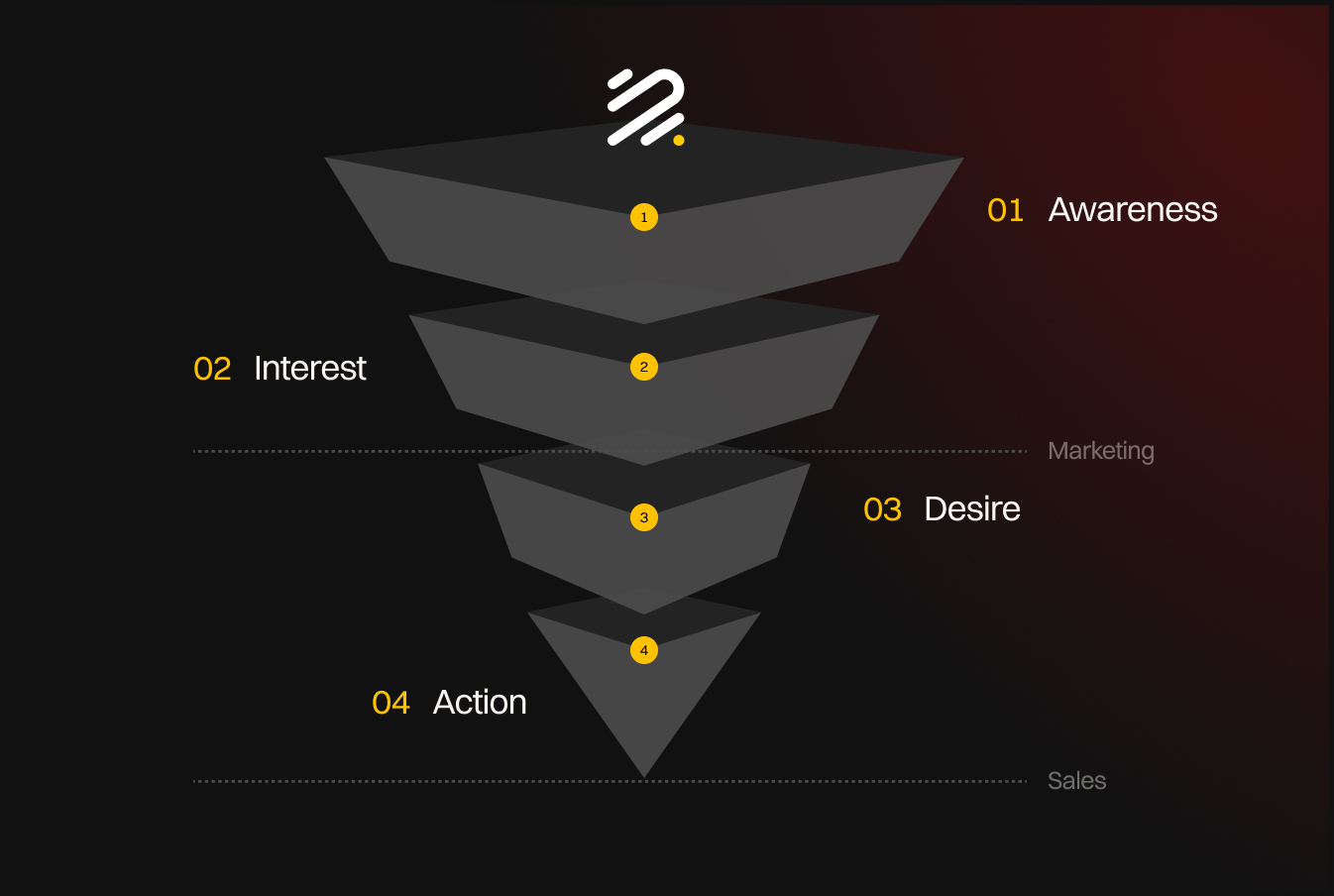 Sales Funnel: AIDA MODEL
Example: Imagine you get peckish during a busy working day. This is the moment of ‘Awareness’ – you are aware of a need. You then think about what you want to eat, which is the ‘Interest’ phase. You remember a bakery where you once had a good sandwich, and that creates ‘Desire’. Finally you decide to go to the bakery and buy the sandwich – that is the ‘Action’.
This example illustrates how you can bring marketing (driving needs) and sales (the actual purchase) together in a funnel. In 2024, modern tools such as marketing automation, personalised email campaigns and chatbots can help guide these phases more efficiently.
Defining your audience
Before you can optimise your funnel, it is important to define your audience sharply. In 2024, AI-driven tools such as Google Analytics 4 (GA4) and other machine learning systems can offer in-depth insight into the behaviour of your online visitors. That goes further than traditional audience analysis; you can now also create specific personas based on visitor data.
Use that data to understand who your customers are, which channels they use, and where their pain points lie. Combined with tools such as heatmaps and conversion optimisation software, you can see exactly where visitors drop out and where they need more attention.
The three biggest mistakes in 2024
In 2024 mistakes are still being made in setting up sales funnels. We list the three biggest pitfalls:
1. Confusing Marketing Qualified Leads (MQL) and Sales Qualified Leads (SQL): Many companies think every point of contact leads directly to a sale. But often leads are looking for information first, before they are ready to make a purchase. In 2024 it is important to set your funnels up so that you take these two groups into account: MQLs who are looking for information and SQLs who are ready to buy. Use specific content and communication for each phase.
2. Getting the audience wrong: It is crucial to understand your online audience well. There is a chance your online audience differs from your offline customers. Tools such as social media analytics and customer data platforms (CDPs) can help you gain better insight into who your online audience is. Make sure your communication and marketing channels are tailored to that audience.
3. An unoptimised website: In 2024, optimising your website for the best user experience remains essential. Things such as too many call-to-action buttons, checkout pages that are too long or confusing navigation can affect the conversion rate negatively. Use A/B testing, CRO tools (Conversion Rate Optimization), and UX analysis to make sure your website is optimised for the best results.
Let us zoom in a little more on the second point, because it relates to the difference between Marketing Qualified Leads (MQL) and Sales Qualified Leads (SQL). When you set up your online sales funnel, at some point you will refer to
your website. It is then important that the information is well aligned with your campaign and the audience you reach.
Work out carefully what the audience wants to know from you and above all how ready this group is to buy. In other
words: how far along is someone at the moment they land on your website within the specific campaign?
Customer journey: crucial in 2024
The customer journey plays a central role in a successful sales funnel. It is important to offer the right information for every phase of the customer journey. Make sure your content is tailored to the phase the customer is in: from orientation to purchase. Personas (detailed profiles of your customers) can help with this. Analyse what your customers need in each phase of the journey and adapt your funnel accordingly.
Also take a look at our approach to see how we handle this for our projects.
Need help defining the customer journey?
What does my online sales funnel look like?
Now that we know what to look out for when defining an online sales funnel, below is a schematic representation of one. Before you set to work filling it in yourself, you should be able to answer the following questions:
Who is your (online) audience?
What do the customer journeys look like?
What is your online objective?
Which channels are used to reach your website?
Do your website and landing pages align with your digital strategy?
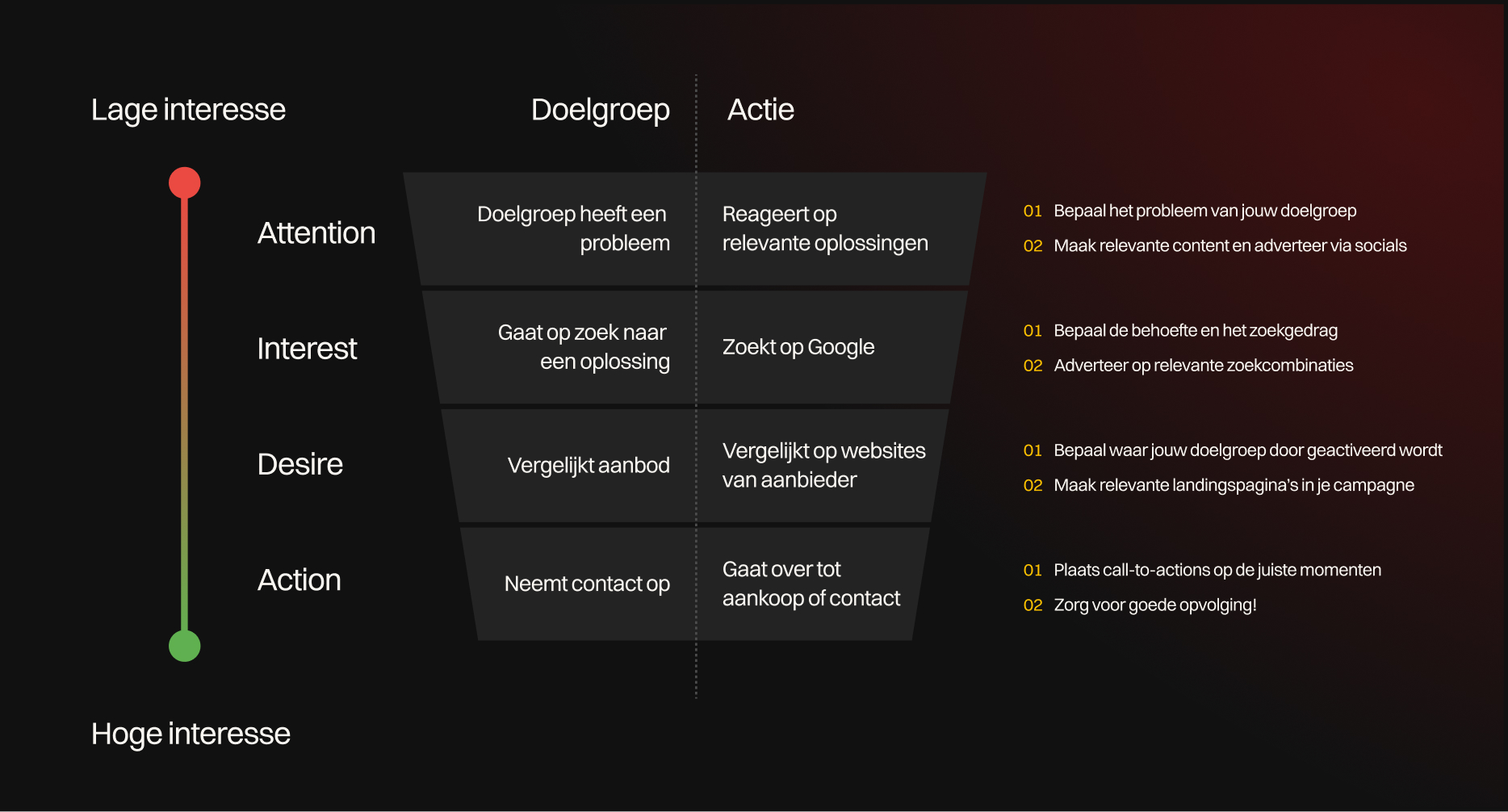 Sales funnel in 6 steps
How do you optimise your sales funnel in 2024?
Optimisation is a continuous process. The digital world changes fast and your audience's preferences change with it. That is why it is important to measure regularly how your funnel is performing. Use advanced measurement tools such as Google Analytics 4, Hotjar, and other conversion analysis tools to see exactly which parts of your funnel could be improved.
Make sure you set measurable goals through KPIs such as the number of leads, the conversion rate and the ROI of your marketing campaigns. It can be wise to bring in a digital marketing agency to implement and optimise your strategy.
Written by

Thomas Groeneveld · Managing Partner & Strateeg